
Get Ready for Agentic Commerce: Is Your Shopify Store Optimised for the AI Customers of the Future?

Have you already noticed the small new app icon in your Shopify? Agentic?
Imagine a customer who does not click their way through Google, category pages, product filters, and product pages themselves. Instead, the customer asks their AI assistant to find the best gift, the right size, the cheapest alternative, or the product that matches a specific need.
That is the core idea behind Agentic Commerce.
Agentic Commerce means that AI does not just help with inspiration. AI can increasingly begin to act on the customer's behalf: searching for products, comparing prices, understanding delivery terms, evaluating offers, building a cart, and guiding the customer towards checkout.
For Shopify stores, this changes the rules of the game. Your webshop no longer only needs to be easy for humans to understand. It also needs to be easy for AI agents to understand — agents that must be able to read your product data, prices, discounts, bundles, stock status, FAQ, and terms of trade.
If the AI agent cannot understand your offering, you risk the customer never being presented with it.
Fortunately, Shopify is right at the forefront where it matters — ensuring your products and categories are ready for the AI future. If your store does not use Shopify, this article is not relevant to you.
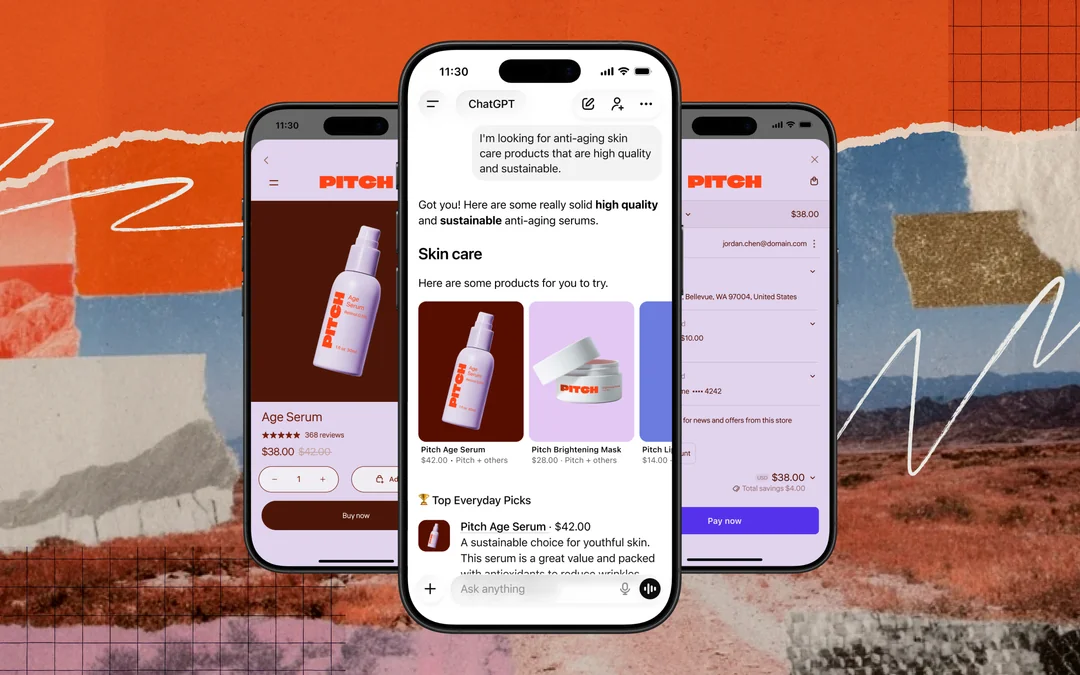
Original prices and discounts must be clearly visible
Many Shopify stores use discounts for campaigns and promotions. This works fine in a traditional customer journey, where the customer sees the discount in the cart or at checkout.
But in an AI-driven buying journey, it can cause problems if the offer is not clearly linked to the product. If a discount only exists as hidden discount logic in the cart, the AI agent may not correctly understand the product's actual price, original price, or saving.
That is why Shopify stores should review whether sale prices, original prices, and discounts are correctly configured at the product level. This makes it easier for customers, search engines, and AI agents alike to understand what the product actually costs — and why it represents a good deal.

Bundles happen in the cart
The same applies to bundles.
If your bundle offers only appear as logic in the cart, through an app, or via a script, you risk AI agents not understanding the offer early enough in the buying journey.
A bundle should be clear and easy to decode. It should be apparent which products are included, what the customer saves, and why the package is relevant. If it is only hidden in the checkout flow, it becomes harder for AI systems to use as a sales argument.
Also remember to fill in Shopify's Knowledge Base. It is an FAQ for AI agents that helps them understand your webshop, products, delivery, returns, and the questions customers typically ask before making a purchase.
Shopify since January 2026
AI-driven traffic
increase in orders attributed to AI searches
of Danes use AI weekly
Review your apps and workarounds
Many Shopify stores use apps for discounts, bundles, product options, size guides or custom logic. That is not necessarily a problem.
The problem arises when important information is only stored in app logic, scripts or visual elements that are not easy to read as product data.
That is why you should review your tech stack and ask yourselves one important question:
If an AI agent had to understand your products, prices, offers and terms of trade without clicking through the entire webshop like a human — would it get the right picture?


