
Bing Webmaster Tools launches AI Performance: See how your content is used in AI answers
Microsoft has officially rolled out a new feature in Bing Webmaster Tools: AI Performance, which is now available in public preview. The feature allows webmasters and SEO specialists to gain insight into how their content is used in AI-generated answers – for example in Microsoft Copilot, Bing AI summaries, and other partner integrations.
AI Performance extends classic SEO data by also measuring how content is cited in generative AI experiences – something that was previously only possible to guess at.
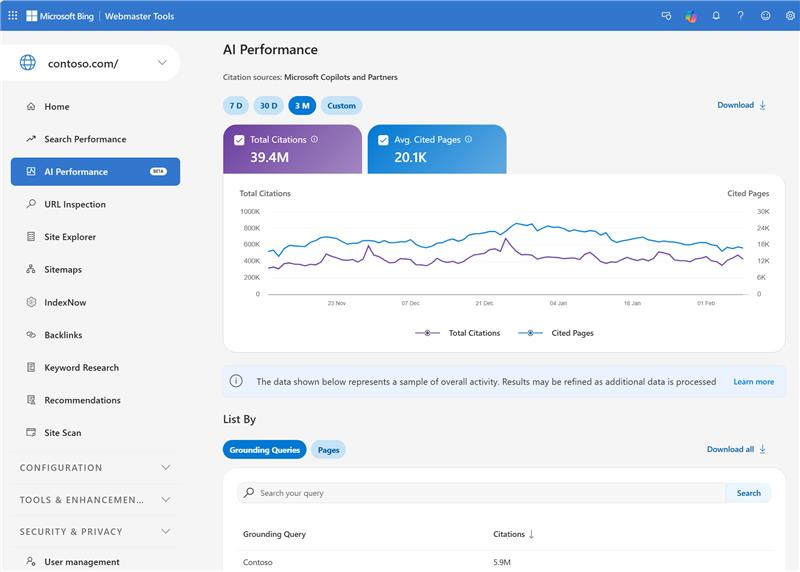
What does the AI Performance dashboard show?
The AI Performance dashboard provides in-depth data on how your content is used in Microsoft AI systems such as Bing AI and Copilot. The metrics, which are specific to Microsoft AI, show:
Total citations: How many times your site has been cited as a source in Microsoft AI-generated answers within a selected period.
Average cited pages: The average number of unique URLs from your site that are used as AI sources.
Grounding queries: Examples of searches (queries) that triggered Microsoft AI systems to cite your content.
Page-level citation activity: Which specific pages from your site are cited most frequently in AI answers.
Visibility trends over time: A timeline showing how citations change over time, for Microsoft AI.
These metrics provide a new perspective on how Microsoft's AI systems (e.g. Bing AI and Copilot) “see” and cite your content. It is no longer only about ranking in Bing search, but also about being used as a source in AI-generated answers on Microsoft's platforms.
For more information on how to use this data, you can read the official documentation here.
Why this matters
Traditional SEO has always been about clicks, impressions, and rankings in search results. But as AI models become an increasingly common way for people to find information – for example through generative answers in Copilot – visibility is now also measured by whether content is used as a reference.
AI Performance therefore marks an important step towards what the SEO community calls Generative Engine Optimization – that is, optimisation focused on AI contexts and citations rather than solely organic rankings.
For now, there are still some limitations. Metrics such as clicks and CTR from AI experiences are not yet part of the dashboard, meaning you still cannot see what impact AI citations have on direct traffic back to the site.
How can you use AI Performance in your SEO strategy?
Although AI Performance is still in beta, the new data can already be used purposefully to:
Identify which pages AI frequently cites: If individual pages are cited often, it typically means they have clear relevance and focus on a topic.
Identify grounding queries: See which user queries lead AI to cite your content – this gives direct insight into which topics AI associates with your brand.
Spot trends in citations: Over time, you can see whether your AI citation patterns are rising or falling, as an indicator of AI visibility and authority.
Prioritise future content: If you notice certain queries frequently triggering citations, you can target new content or improve existing pages to better match those queries.
AI Performance changes the way we measure visibility
AI Performance in Bing Webmaster Tools represents a shift in the way we think about SEO. While classic metrics such as clicks, rankings and CTR remain important, AI citations will become a supplement that shows whether your content is being used as the basis for generative responses in AI experiences.
This does not mean that traditional search data becomes irrelevant. But if your target audience is increasingly using AI assistants to find answers, it is worth knowing how often the AI cites your pages specifically, rather than simply measuring classic rankings.


