ChatGPT Ads - Your next ad talks back.
Early presence and measurable impact in Denmark's newest advertising channel.

How to track your ChatGPT ads, starting today
OpenAI has opened both client-side and server-side tracking for advertisers in ChatGPT. We are already setting up a solid configuration for clients on the channel: the OpenAI Pixel via Google Tag Manager, without code changes, combined with server-side data through the Conversions API — typically in a hybrid setup deduplicated via a unique event ID, as OpenAI itself recommends.
Events such as add_to_cart, sign_up and purchase are enriched with transaction details and CRM data for more precise conversions, and if you already have a server-side container — for example via Stape — we connect it directly. The result: you can measure your ChatGPT ads correctly from the very first penny.
How people buy today
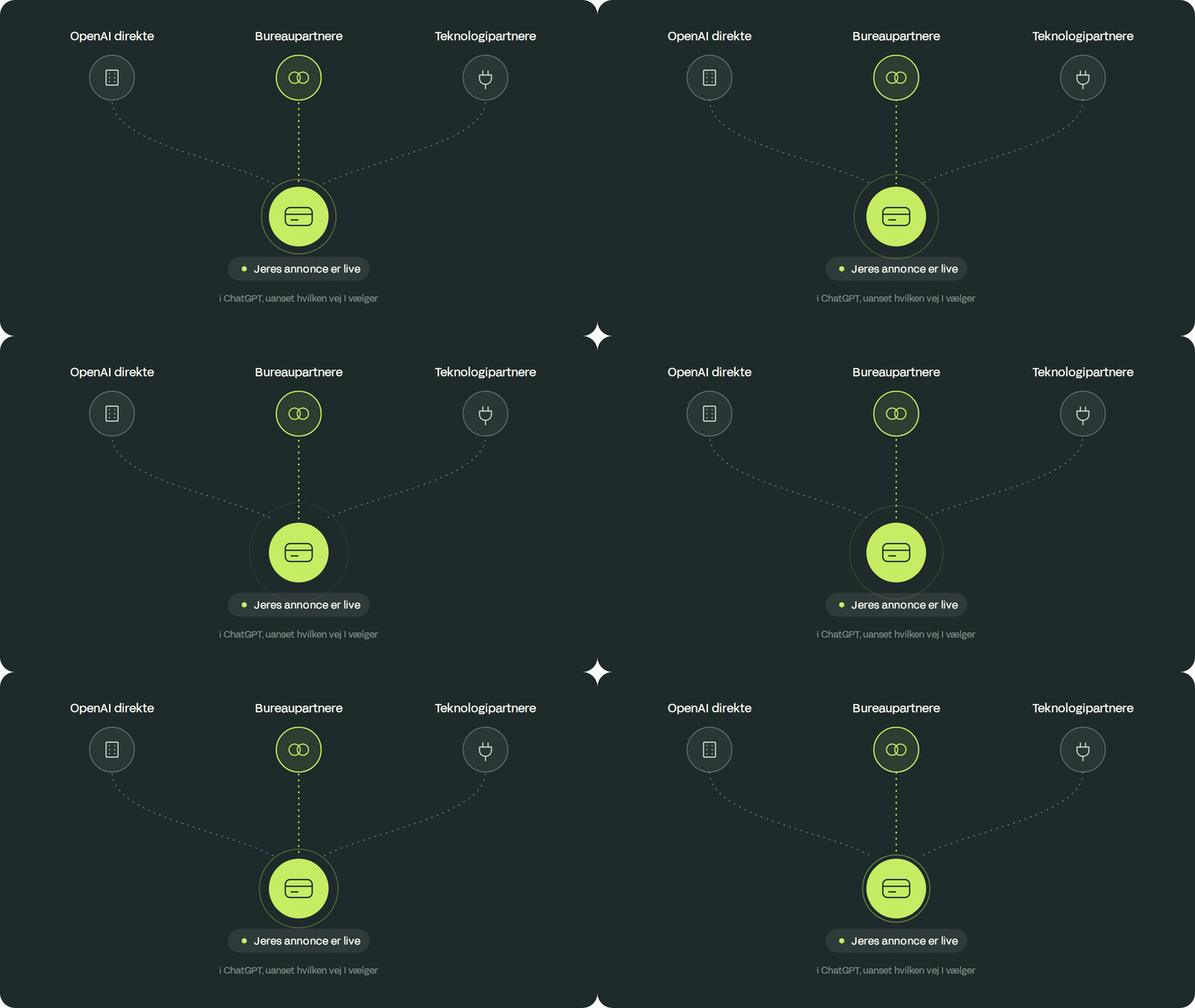
The self-service platform is now open in Denmark. You can create an account at ads.openai.com, add a payment card and get started straight away. We follow the setup closely and ensure that your tracking, feed and landing pages are ready, whether you set up the campaigns yourself or book through OpenAI's Ads Solutions team or an agency/technology partner.
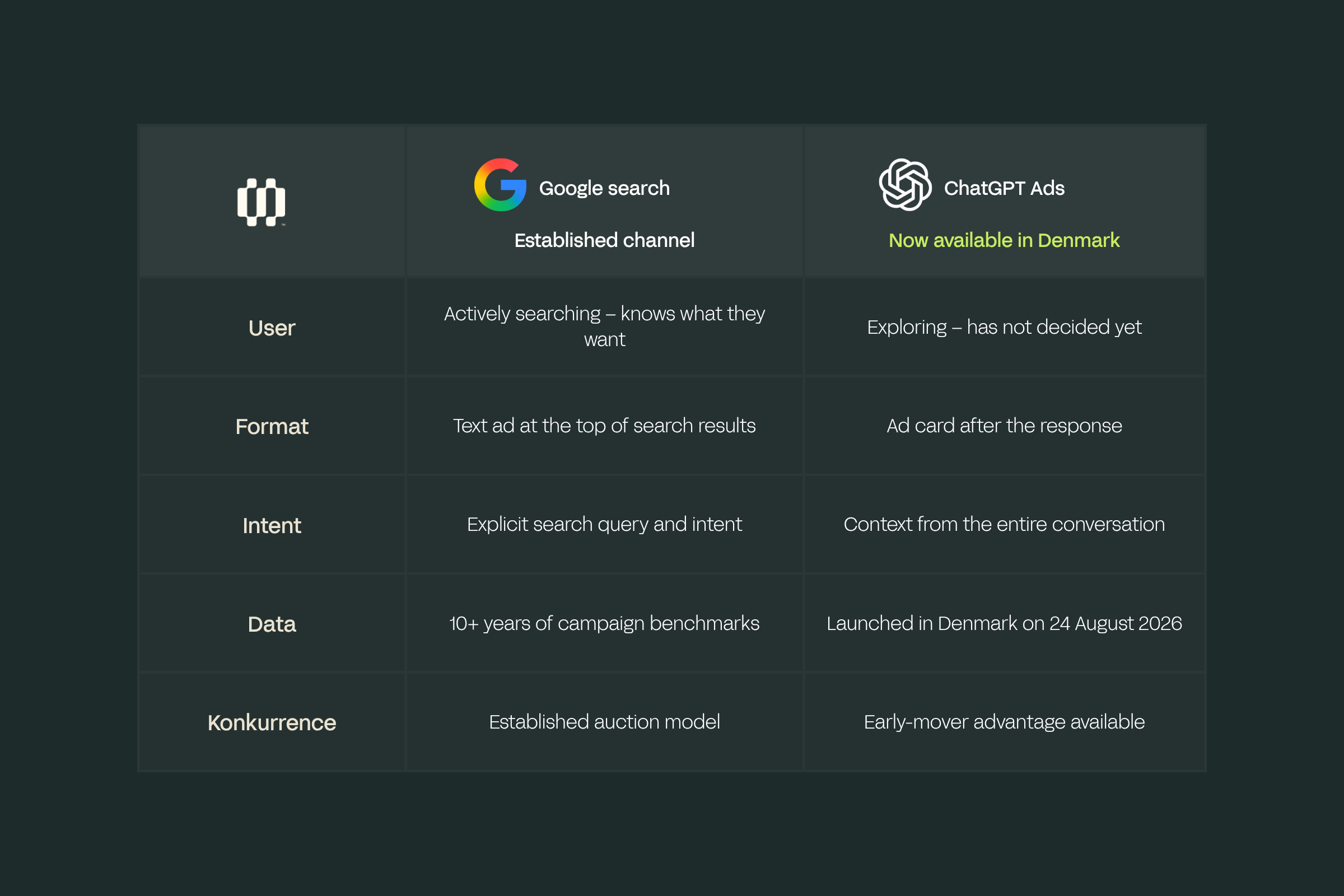
Looks like Google Search. Doesn't behave like it.
The difference determines how you should think about the channel — not just what it costs, but how you build for it.
The table on the right shows the differences in headlines. What actually matters for your decision is what those differences do to behaviour.
In Google Search, the user has typically already decided on a direction: they type something like "running shoes women" or "accountant Copenhagen" and click through a list of options.
In ChatGPT, the user is often still in the process of thinking things through. They describe a need, receive an answer, ask follow-up questions — and the ad only appears once the conversation has given ChatGPT a context to match against.
Your ad is therefore not competing to be found. It is competing to be relevant enough to be noticed after the user has already received an answer they trust.
Paid, cited, purchased
Three ways to exist in AI. Each solves a different problem — but all must be decided together.
ChatGPT Ads
You buy a sponsored placement after the answer. The fastest of the three to measure, but dependent on both budget and the purchase journey, and it stops working when the budget stops. Advertising does not affect the answer itself.
This pageGEO and AEO
You optimise to be mentioned and cited in the answer. Slower to build, but it continues to deliver without ongoing media spend, and it is the only way into the recommendation itself.
See GEO and AEO →Agentic Commerce
You prepare for an AI agent to complete the purchase on the customer's behalf. Product data, feeds and technical setup must be readable and actionable by a machine, not just readable by a human.
See Agentic Commerce →Get a potential assessment
Free. No commitment required upfront. If the answer is no, you'll receive it with an explanation.
Contact us

Ready for ChatGPT Ads?
FAQ
An ad in ChatGPT is a sponsored card displayed after ChatGPT's response — not inside the response itself. It is always clearly labelled as sponsored and visually separated from the answer. OpenAI states that advertising does not influence the response ChatGPT provides.
Logged-in adult users on the Free and Go plans see ads. Users on Plus, Pro, Business, Enterprise, and Education see no ads. Users under 18 see no ads. Ads are also not shown in conversations on sensitive topics such as health, mental health, and politics.
No. OpenAI states that advertising does not influence the answers ChatGPT provides. Paid placement gives you visibility alongside the answer, not within it. If you want to be mentioned and cited in the actual answer, that requires generative engine optimization (GEO) and answer engine optimization (AEO) — organic work involving content, structure, and authority.
In Google Ads, you bid on keywords and compete for a click in a results list. In ChatGPT Ads, you bid into a conversational context, and the ad is shown after the user has received their answer. OpenAI matches ads to the topic of the conversation, previous chats, and previous ad interactions. No keyword-based mechanism has been made public. Intent in ChatGPT is typically longer and more exploratory, and around 20% of queries show direct commercial intent.
The channel makes most sense for businesses whose customers research a product before purchasing, and whose target audience is likely using ChatGPT on the free or Go plan. It makes less sense if the audience is on Plus, Pro, Business, or Enterprise, if demand primarily arises in conversations about health, mental health, or politics — where ads are not shown — or if there is still untapped potential on Google Search and Shopping. There are no published performance benchmarks for the channel, so an initial effort should be treated as a test with its own success criteria.
Three things. Conversion tracking that works, so a new channel can be measured fairly — preferably server-side. A clean product feed if you sell products, so the channel can read category, price, and inventory correctly. And landing pages built for a user who has just read a longer answer on the topic, not for a short keyword click. All three simultaneously benefit Google and Meta, regardless of whether ChatGPT Ads delivers.
Advertisers only receive aggregated information about how their ads are performing. Advertisers do not have access to users' chats, chat history, memory, or personal details. It is OpenAI that matches ads to the conversational context — not the advertiser targeting individuals.
We are already in the process. Searchmind has been approved as an advertiser and is live with our own ads in ChatGPT. The channel is still so new that no Danish advertiser or agency — including ourselves — has a documented track record yet, but we are actively testing, which means we have first-hand experience with the setup when your campaigns are ready to launch. This builds on our proven expertise in paid search and on the organic side of AI search through GEO, AEO and Agentic Commerce.
Yes. Ads in ChatGPT are rolling out in Denmark from 24 August 2026 as part of a rollout to 31 European countries. The self-service platform (ads.openai.com) is now open in Denmark, so you can create an account and set up campaigns yourself. Alternatively, you can book through OpenAI's Ads Solutions team, agency partners or technology partners.


