What is a Customer Journey?
A Customer Journey is what we call a "customer journey" in English. The Customer Journey is a customer's journey from being a stranger to becoming a loyal customer of a company. In other words, the customer journey is the sum of the experiences and interactions a customer goes through before and when they make a purchase from a company.
A Customer Journey is 100% unique for each individual customer, so when working with customer journeys – for example in marketing and sales – you work with a generalisation of the typical customer's (target audience's) journey.
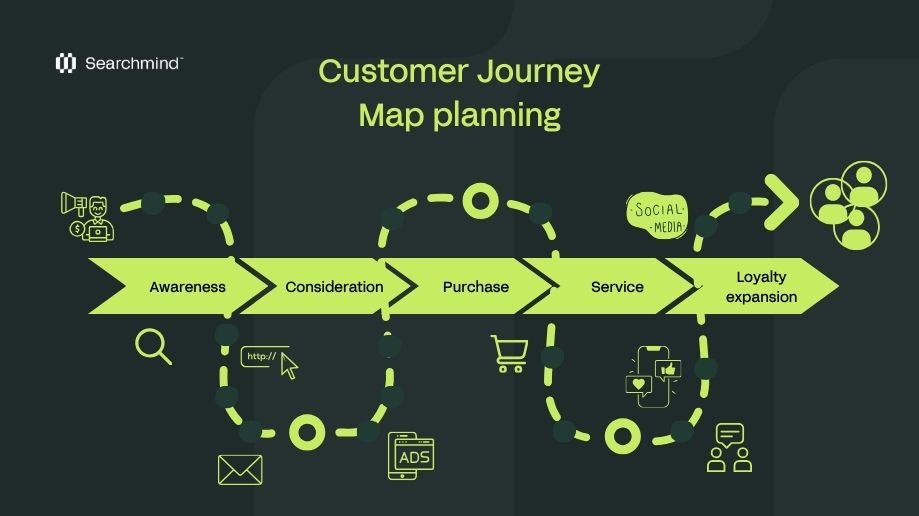
A simplified way to view a customer journey is to divide it into five phases that all customers move through on their way to a purchase:
The 5 phases of a customer journey
- Attract: the customer does not know they have a need, so the need must be awakened (e.g. through the use of social media, YouTube, influencers, blog, etc.)
- Interest: the customer discovers there is an unmet need, develops interest and investigates further (Googles, talks to acquaintances, etc.)
- Convert: the customer begins to explore alternatives and is converted into a "lead" with a company (e.g. by signing up for a newsletter, downloading material, or similar)
- Close: the customer is "closed" and moves from being a lead to becoming a buying customer (e.g. through personal sales, email marketing, or similar).
- Delight: the customer becomes loyal to the company and spreads the message to other potential customers (e.g. through personal sales, customer service, email marketing, or similar)
This journey is also typically illustrated using the funnel model, which describes the 5 phases and how the number of potential customers becomes smaller and smaller the further down we move:
An example of a Customer Journey
Below you can see an example of a customer journey:
- A person in the target audience is exposed to an advertisement on social media.
- The person searches on search engines for more information.
- The person finds additional, relevant information on your website.
- The person signs up and downloads relevant material, in relation to where they are in their decision-making process on your website.
- The person is guided further through their decision-making process and gains greater knowledge of the product and you as a provider through email marketing and marketing automation.
- The person makes a purchase after having been in contact with a salesperson.
- The person continues to be influenced through emails, customer service, etc., which strengthens the relationship between the customer and the company, reflected in repeat purchases and word-of-mouth marketing.
But as mentioned, every customer journey is 100% unique, and typically a customer has between 5–10 touchpoints on the way to a purchase – and often even more. It is about mapping your own target audience's customer journey. And that is what we look at more closely in the next step.
Customer Journey Mapping: What is it, and how to do it
Customer Journey mapping is the process of defining and visualising your target audience's customer journey. In other words, mapping how the customer's journey typically looks and, as part of this, how you as a company support this customer journey.
And how do you map your customer journey? You do it by collecting data that helps you understand your customers and their journey, and using this knowledge to create a customer journey-driven marketing strategy – where channels, messages and tactics are tied together and work in sync with each individual customer's journey.
Below you will find 6 concrete steps for working with your customer journey:
Customer Journey mapping: Step-by-step
- Get control of your data: Find and use data from Google Analytics, the various advertising tools, etc. (including associated attribution models)
- Define your target audience: Have a thorough understanding of your target audience.
- Understand the customer's goals in each phase of the customer journey: What do they want to find out in each phase of their journey?
- Define all conceivable touchpoints: Where do they try to find answers? Search engines, website, social media?
- Are we fulfilling gains and eliminating pains?
- Establish the typical customer journey: Based on qualitative (talk to the rest of the organisation, your customers, etc.) and quantitative data (attribution models, etc.)
- Prioritise, work and create flow between the individual channels: Selection of marketing channels, messages, and creating synergy in relation to the customer journey.
- Data, evaluate, optimise. Repeat: Set KPIs, measure, collect data and optimise.
Do you want to optimise your Customer Journey and improve your marketing strategy?
Call us on 30 12 42 72 for a no-obligation chat about how we can help you map your customer journey and increase sales!


