Google has expanded its position in the global AI landscape in recent years, and the company's Gemini models now play a central role in that development. The technology is no longer limited to Google's own products – it is increasingly being integrated directly into other systems through strategic partnerships and technological collaborations.
Google accelerates the adoption of AI
Google's AI model Gemini is designed to work across devices, applications and platforms – from Google Search and Android to external integrations. This enables the creation of more coherent and context-aware AI experiences, where the technology works more closely with the user's data and behaviour.
At the same time, the framework for development is being strengthened through new collaborations – including within e-commerce, where Gemini already enables users to find and purchase products directly in the chat without leaving the conversation.
Apple partnership: Gemini as the foundation for iOS AI
One of the most significant steps in 2026 is the new collaboration between Google and Apple, in which the Gemini models will form the basis for future AI features in iOS.
This means that Gemini will become the primary AI engine in Apple's AI layer, and that iPhone users will encounter Google's technology directly in their native experiences – for example in a new version of Siri and in the upcoming “Apple Intelligence” features.
Apple maintains its usual approach to data security with on-device processing and Private Cloud Compute, but the collaboration underlines that Google now takes on a central role in the underlying AI infrastructure of the world's most widely used mobile ecosystem.
The AI landscape is moving towards built-in experiences
Google's strategy reflects a clear movement in the AI industry: technology is shifting from being a separate tool to becoming an integrated part of the systems we already use.
This means, among other things:
Deeper system integration: AI becomes a permanent part of both Android and iOS.
Consistent experiences: Users get similar AI features across devices.
Increasing competition: The biggest players – Google, OpenAI, Anthropic and Meta – are now competing not only on model quality, but also on where AI lives within the user's ecosystem.
A shift in the AI landscape
Google's technological rollout and partnerships demonstrate how Gemini is gradually becoming a natural part of users' digital everyday lives.
Although OpenAI still holds the largest user base, Google is significantly strengthening its position – not only by developing new features, but by embedding its technology directly into the systems users rely on daily.
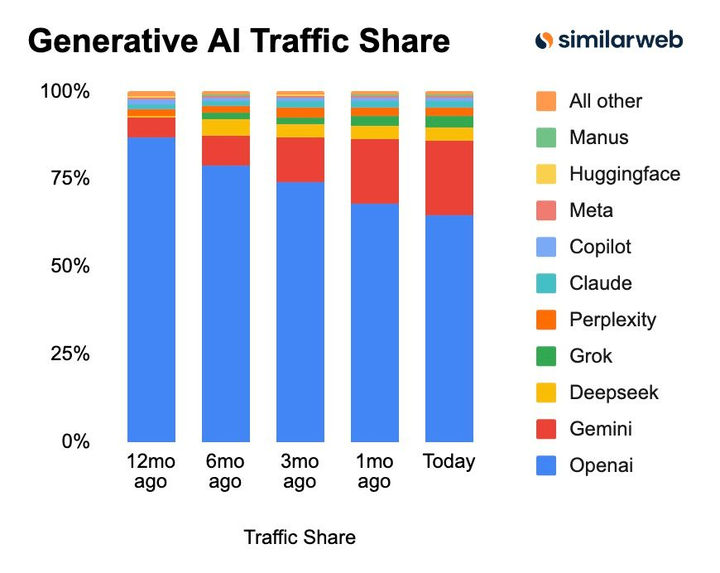
Relative reach of AI platforms
The graphic shows the current distribution in the AI landscape, where OpenAI remains by far the most widely used platform, but where Gemini is experiencing clear growth, driven particularly by increased use of Gemini Chat. This development is not yet directly linked to the new partnerships, but indicates that Google's AI is beginning to gain traction among users globally.
Although Google entered the arena later than OpenAI, they have now picked up considerable pace. The technical quality of the Gemini models and a targeted effort to integrate AI into Google's products means that Gemini is quickly beginning to capture market share. Google's strength lies in the combination of large scale, distribution power and a product that technically matches – and in certain contexts surpasses – its competitors. This underlines that the AI market is no longer dominated by a single player, but is increasingly moving towards a more balanced and competitive landscape.


