Paid social vs. onsite popups
Onsite popups are an effective tool for capturing email subscribers, but they rely on people already visiting your webshop. Paid social gives you the opportunity to reach new potential customers who have not yet visited your webshop, helping you fill the marketing funnel with qualified leads.
By combining paid social with onsite popups, you can extend your reach and capture more subscribers. Once they have signed up, you can communicate with them via email and create a more personalised experience based on their preferences and behaviour. In addition, this approach enables you to build a rich source of data about your customers' interests. You can use this data to target your email campaigns and paid social ads even more precisely, creating a strong synergy between channels and enabling you to increase conversions and customer loyalty over time.
Leveraging data for effective conversions
In an era where access to third-party data is becoming increasingly limited, it is more important than ever to focus on the data you own yourself. Zero- and first-party data are becoming the key to more precise targeting and higher conversions now and in the future.
Automation and integration of your tools are essential to fully leverage this data.
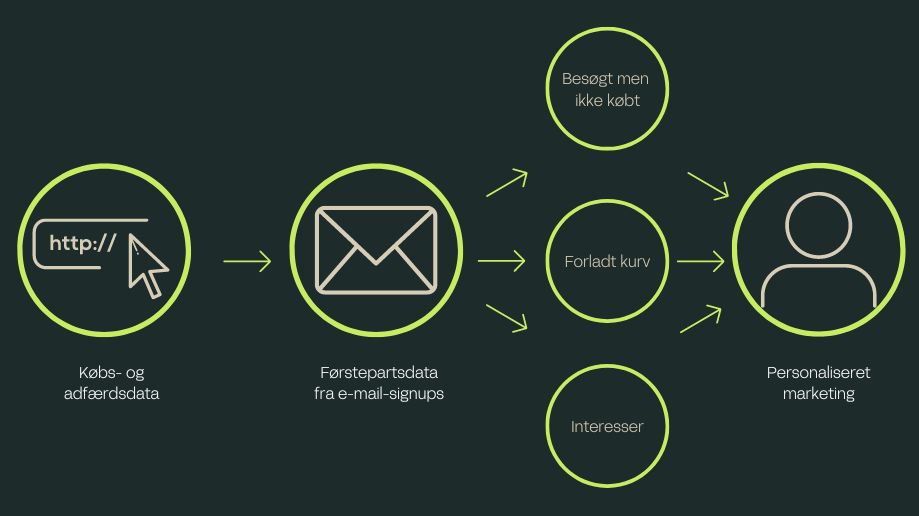
An effective way to leverage the synergy between paid social and email marketing is by integrating your Email Service Provider (ESP) with your paid social campaigns. With a platform like Klaviyo, you can consolidate data across channels and use it to optimise both your ads and emails. This gives you deeper insight into your customers' behaviour, preferences, and purchase history, enabling you to target your campaigns even more precisely.
By segmenting your audience based on behaviour, purchase history, and interactions, you can create targeted email campaigns that both increase conversion rates and strengthen customer loyalty. For example, you can send personalised offers based on previous purchases or set up automated flows that follow up on customers' interactions with your emails.
Examples of valuable segments based on your ESP data can include:
- Abandoned cart within a specific number of days
- Has purchased, but not within the last x number of days
- Has purchased a specific product category
- Most interested in a specific material or category
- Opens campaign emails but has not purchased within a specific number of days
- Returning customers who have purchased multiple times within the last x number of days
- Has made a purchase
These segments can also be used to create lookalike audiences, enabling you to reach new potential customers based on existing data. By using advanced segmentation techniques, lookalike audiences, and retargeting, you can ensure you reach the most relevant customers, maximising the effectiveness of your marketing efforts.
To get the full benefit of your paid social campaigns and ESP data, it is important to create a coherent, data-driven strategy. Balance short-term sales goals with building a strong and loyal customer base by continuously experimenting with different campaign formats and targeting techniques, while adapting your strategy based on performance. By combining first-party data with third-party data, you can achieve better results and strengthen your campaigns over time.
Continuous optimisation
To ensure your paid social campaigns are as effective as possible, it is essential to take a systematic approach to both analysis and optimisation. By holding your business up against your advertising, you can identify whether your setup best supports your customers' needs. For example, you can look at whether your customers face challenges that can be addressed through targeted advertising, or whether there is behaviour on your website that needs to change. Your campaign structure must continuously support your business and your customers' needs.
Once your advertising setup is solid, you can begin exploring optimisation opportunities. It may be that certain segments of your audience are not being addressed, or that your ads can be made more relevant by basing them on updated customer data from your ESP.
In this context, it is important to combine zero- and first-party data — such as purchase data — with third-party data to gain a more complete understanding of your customers.
An effective optimisation strategy also involves analysing how different segments of your audience respond to your campaigns. By using data from your email marketing platform, you can measure KPIs such as ROI, engagement, and conversion rates, and thereby identify where there is potential for improvement. If you discover that certain segments have higher engagement or conversion rates, you can tailor your ads and email flows to maximise their effectiveness.
This approach ensures you can continuously adapt your campaigns so they remain relevant and profitable. By combining your own customer data with third-party data, you can respond quickly to changes in customer behaviour and the market, maximising the return on your investment in paid social.
Overall, the key to success is to view Paid Social and Email Marketing as two sides of the same coin. By combining the strengths each channel brings to the table and continuously optimising based on data, you can create a powerful marketing strategy that delivers both short-term and long-term results.


