What is a URL and what does URL stand for?
The term "URL" stands for "Uniform Resource Locator". In everyday language, a URL is simply referred to as an "address". A URL is therefore the term for a web address such as https://google.com. This is a URL/address.
The different elements of a URL
A URL is made up of several different elements. These are listed below with a brief comment/explanation attached to each.
Protocol
The first part of a URL is the protocol — i.e. "HTTP" or "HTTPS". This is a so-called internet protocol used by a web server (the server hosting the website) and a web client (a device attempting to access a web server's content, e.g. your computer) to exchange information.
Subdomain
Some URLs are placed on so-called "subdomains". Subdomains are "sub-domains" of the primary domain. An address such as https://blog.bilbasen.dk/ is a subdomain of the domain "bilbasen.dk". Websites located at "www.domain.dk" are likewise placed on "www" subdomains.
If the URL is not placed on a subdomain, there will be no subdomain present in the URL.
Domain name
The next element of a URL is the domain name. The domain name is a name that the website is associated with and resides on. The domain name for the news outlet Danmarks Radio is, for example, "dr".
ccTLD
The next aspect of the URL is the so-called "ccTLD", which stands for "Country Code Top Level Domain". Every country in the world has its own ccTLD. In Denmark we use .dk, and it is DK-hostmaster that manages all .dk domains. In addition to country-specific top level domains, there are also so-called generic top level domains such as ".com", ".org", ".net", etc.
Path
Unless you are dealing with a homepage URL such as https://searchmind.dk, the next part of the URL will be the path to the file on the website you are trying to access. Taking a URL like https://www.searchmind.dk/on-our-mind/seo/, the path in this case is "on-our-mind/seo/".
Parameters
Last but not least, certain URLs contain so-called parameters. These parameters are used to create dynamic pages where the content changes based on what the parameters in the URL contain.
When you filter and sort on a webshop, for example, it is often URL parameters that ensure the filtering/sorting works as intended.
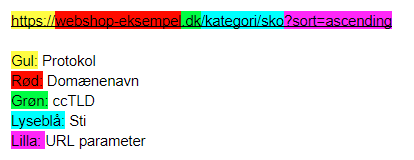
An example of a sorting address could be: https://webshop-eksempel.dk/kategori/sko?sort=ascending. This parameter will sort the products by the value "ascending", which typically means in rising order.
The image below shows all these different elements that a URL can be made up of, presented graphically, and may therefore be a little easier to take in:
Do you need help understanding and optimising your URL structures for better SEO and user experience?
We can help you structure your URLs correctly and ensure that your website is easy to navigate. Fill in the form below or call us on 30 12 42 72 for a no-obligation chat!


