
Biggest Google Update in 25 Years: Is Your SEO and PPC Strategy Ready for the AI Revolution?

Google itself calls it the biggest upgrade to the search engine in 25 years. The future isn't on its way. It landed on Tuesday.
Google I/O 2026 has made it unequivocally clear: the premise for digital visibility has changed fundamentally. If there is still a belief that AI in search is a distant future trend, take a look at the staggering official figures the tech giant has just put on the table:
Monthly users on AI Overviews
Number of monthly users on AI Mode

From search engine to an acting AI assistant
Google is no longer just a passive list of blue links, where users click around and compare manually. Google is becoming a proactive AI assistant that guides, answers and executes actions directly in the search result.
With the rollout of advanced AI agents, we are seeing a significant shift in user behaviour:
Multimodal search: Customers no longer search with only short, isolated keywords. They ask long, nuanced questions, upload images of their problems directly into the search and expect precise, tailored answers immediately.
Rise in "Zero-Click Searches": The AI generates ready-made solutions at the top of the screen. This means that traditional organic and paid traffic is changing in nature, as many users find answers without ever clicking through to a website.
E-commerce revolution: AI agents will increasingly be able to compile products, check stock status and assist with purchasing decisions directly within the Google interface.
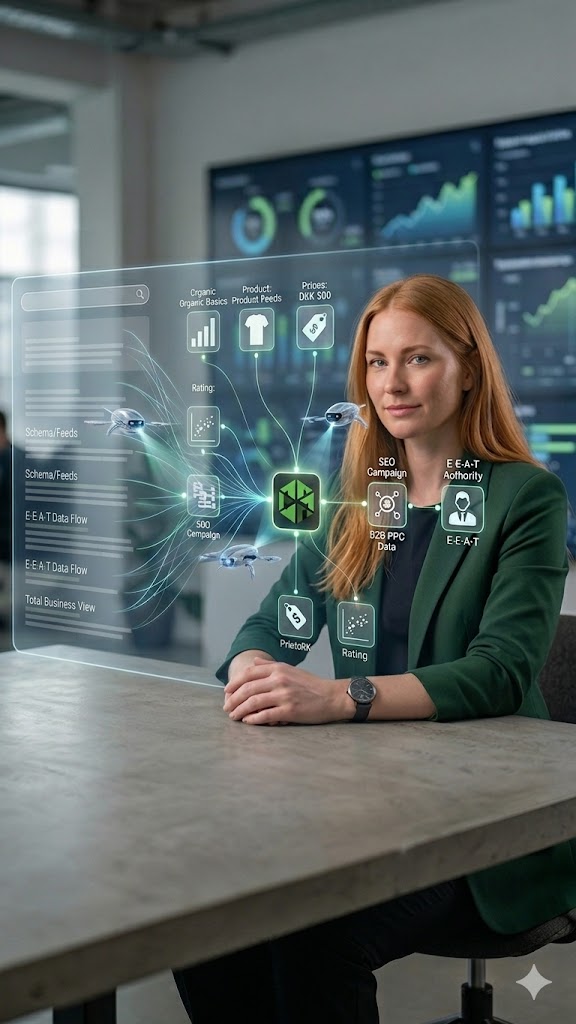
The new task for marketing executives
This is not the end of digital marketing, but it is the final death blow to superficial strategies that are solely about "buying cheap clicks".
As the search engine transforms itself, your strategic task changes fundamentally. It is no longer about optimising against a static algorithm or chasing isolated rankings for specific keywords. Instead, you need to look across the entire business and ensure that your brand, your products and your structured business data are optimised so flawlessly that Google's AI agents can instantly read, understand and navigate them.
This requires a shift from traditional content production to a well-executed data structure. AI agents operate on the basis of logic and connections; if your product feeds, prices, reviews and knowledge base do not speak the same language that the AI decodes, your business will be ruled out of the decision-making process. If the AI cannot decode your data, you simply do not exist in the searches of the future.

3 strategic moves your business needs to make now
Your feeds (such as Google Merchant Center), structured data (schema markup) and technical foundation must be 100% up to date and transparent. AI agents must be able to instantly retrieve your specific stock status, prices and product specifications.
AI is brilliant at summarising generic facts. That is why your most important currency will be content grounded in genuine expertise, original data, your own case studies and in-depth human experience. You need to be the authority that Google's AI chooses to highlight as the definitive source within its answer.
Prepare your content for visual searches and complex, conversational queries. Ensure your images are of the highest quality and that your written material directly and clearly answers the real problems your target audience uploads images of or asks about.
Are you still optimising by the old rules?
The companies that manage to adapt and build the strongest data foundation in time will win the market in 2026. The companies that choose to wait and see risk losing critical visibility and market position.
Are you unsure whether your current marketing strategy and digital foundation is equipped to be read and understood by Google's new AI agents? Reach out to us at Searchmind – and we'll have a strategic conversation about how we future-proof your visibility and digital performance.


