The basics of attribution: Assigning value to touchpoints
In its simplest form, attribution can be described as the process of assigning credit or value to the various channels and touchpoints along the customer's buying journey. By allocating value to specific touchpoints, you gain a picture of which digital channels are effectively contributing to your business's success.
A example where mistakes can be fatal
Let's take an example: imagine the customer journey begins with an ad on Google Ads, but the purchase is completed via an organic search result. In this scenario, it would be a mistake to shut down your Ads campaign, as doing so could indirectly harm your SEO performance.
In this case, your SEO performance would suffer from cutting off an important entry channel that generates positive traffic and supports SEO results.
In other words, attribution is about viewing the overall marketing mix as a whole and determining which channels contribute which influence on sales. This helps you identify where to allocate your budgets in order to maximise the effectiveness of each individual marketing activity.
The importance of accurate attribution
When you can correctly attribute revenue and conversions to the relevant channels through your chosen attribution model, it becomes clear which of your digital channels are delivering results and which are not. This enables you to either optimise or phase out underperforming activities.
Ignoring this insight can have significant consequences for your performance.
The consequence of inaccurate attribution
Imagine this scenario: a potential customer sees a banner ad on TV2.dk for one of your products. The ad sparks curiosity and the person clicks to read more about the product. Later, the customer searches elsewhere to find the product at a lower price, but without success. Eventually, the customer returns to your webshop via a search engine and completes the purchase.
Traditionally, the search would receive credit for the final purchase, but in reality it was your ad on TV2.dk that triggered the sales process. Without that ad, the final conversion would likely never have taken place. This underscores the importance of precise attribution, so that each digital channel is assigned the value it deserves.
From traditional attribution models to data-driven attribution
Let's look at the most common attribution models in a platform that most people are familiar with — namely Google Analytics. In 2023, Google phased out the previous Google Universal Analytics (UA) in favour of Google Analytics 4 (GA4), which brought significant changes to how attribution could be carried out within the platform.
In GA4, Google phased out several traditional attribution models that are no longer considered effective or relevant. These changes are part of a broader effort to modernise and improve the available tools for data-driven analysis and attribution.
Phased-out models in Google Universal Analytics
The models no longer available in GA4 include:
- First Click: This model assigned all conversion value to the first touchpoint in the customer journey.
- Linear: This model distributed credit equally across all touchpoints that contributed to the conversion.
- Time Decay: This model assigned more credit to touchpoints that occurred closer to the time of conversion.
- Position-Based: This model combined elements of the First and Last Click models by assigning more weight to the first and last touchpoints in the customer journey.
Although these models were valuable for understanding the fundamental impact of different channels, they lacked the flexibility to handle complex customer journeys and cross-channel interactions effectively.
Current models in Google Analytics 4
The primary model used in GA4 is the data-driven attribution model, which uses machine learning to evaluate the effectiveness of each marketing touchpoint based on the contribution each action makes to the overall probability of conversion.
In GA4, you can also manually switch to the “last-click” model, which we will cover in more detail below.
The difference between “last-click” & “data-driven” attribution
In GA4, there is a significant difference between last-click and data-driven attribution when it comes to assigning value to conversions. Let's take a closer look at the differences:
- Last-click attribution is a traditional attribution model in which all the value of a conversion is assigned to the last touchpoint the user interacted with before the conversion took place. This approach often overlooks earlier touchpoints or channels that contributed to driving traffic or creating awareness of the product or service. Last-click attribution provides a linear understanding of the conversion path and frequently underestimates the significance of earlier interactions.
- Data-driven attribution in GA4 is, as described earlier, an advanced approach that uses machine learning to analyse data and assign credit to different touchpoints based on their relative contribution to conversions. Unlike last-click attribution, data-driven attribution takes all touchpoints in the customer journey into account and weights them according to their influence on conversions. This approach provides a more nuanced and accurate distribution of value, as it rewards touchpoints that may not have been the last but still played a significant role in guiding users towards a conversion.
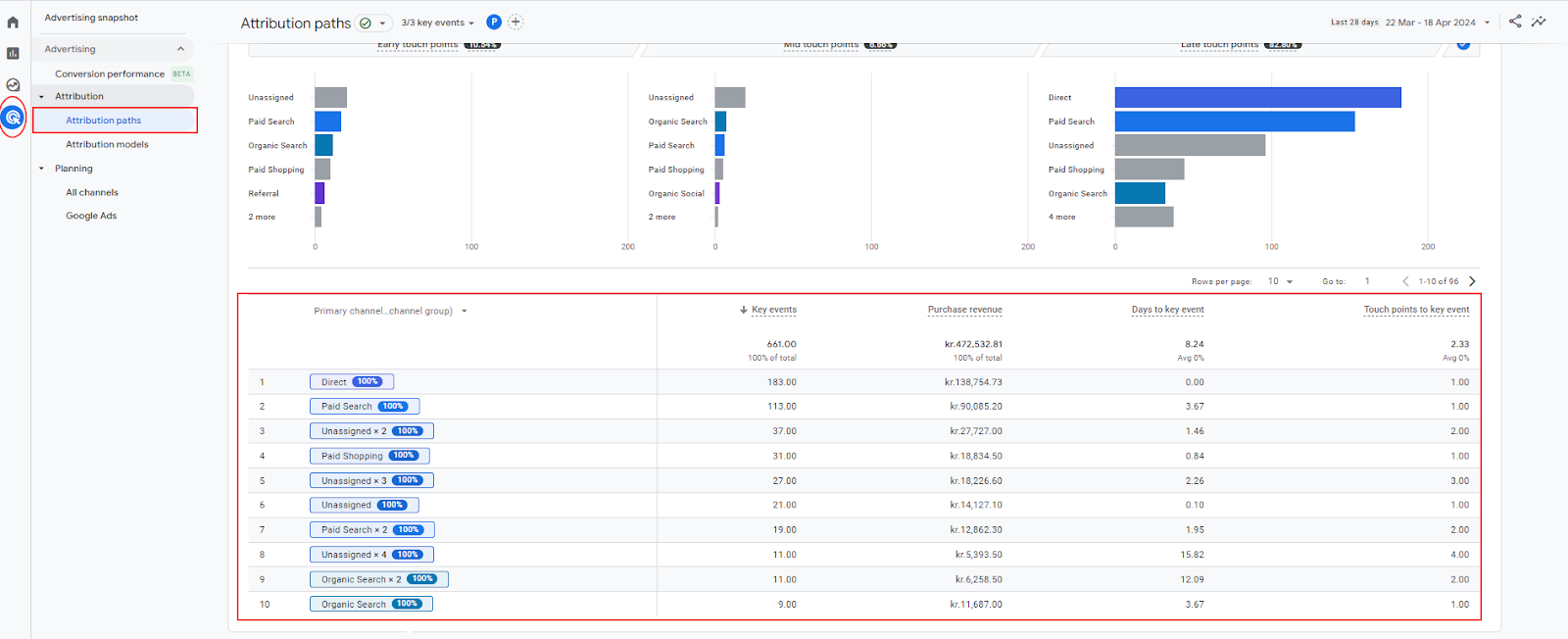
Top conversion paths
In Google Analytics 4, top conversion paths provide insight into the most effective routes users take to convert on your platform. These paths show the various interactions and touchpoints users have had before completing a conversion.
By analysing top conversion paths, businesses can identify the most influential marketing channels and touchpoints in the customer journey and optimise their marketing strategies accordingly. This provides a deep understanding of how different marketing efforts contribute to conversions and helps improve ROI.
Here you will be able to see all the paths that have involved more than one click in the customer journey:
Integrating offline data in GA4
To track interactions from offline channels such as print ads, events and TV spots in GA4, you can implement QR codes and unique promo codes that direct users directly to a landing page or a specific section of a website. When a user scans a QR code or enters a promo code, this action can be recorded as an event.
Here you can assign value to the offline touchpoints based on their role in the conversion process. This can be done by applying data-driven attribution, which automatically adjusts the weighting of each touchpoint based on its influence on the conversion.
To set up offline conversions, you need to:
- Create QR codes or promo codes that contain URLs with UTM parameters. These parameters should precisely reflect the source (e.g. "print_ad" or "tv_spot"), the medium (e.g. "offline"), and the campaign name in order to isolate this traffic in analytics reports.
- Set up event tracking in GA4: When the user lands on the website via a QR code, an event is triggered, which must be correctly configured in GA4 to capture these interactions. This involves setting up custom events that register when a URL with specific UTM parameters is visited.
If you are unable to track online, you can use the Data Import feature in GA4 to upload offline conversion data.
The benefits of data-driven attribution
Data-driven attribution in GA4 represents a significant improvement in how data is analysed to better understand the customer journey. The benefits of this approach are outlined below.
Advanced data analysis with machine learning
Data-driven attribution in GA4 uses machine learning to analyse large volumes of data from different touchpoints. This provides an in-depth understanding of how each interaction influences the customer's decision to convert, representing a significant improvement over the more static models used in Universal Analytics.
Integration of data from multiple platforms
GA4 integrates data across different devices and platforms, which is essential at a time when consumers frequently switch between devices and interact with brands through multiple digital channels. This cross-platform approach ensures a more holistic analysis of user behaviour, improving the accuracy of attribution data.
Detailed insight into user interactions
By analysing interactions at a detailed level, GA4 can identify the specific actions or campaigns that contribute most to conversions. This enables more targeted and effective budget allocation and a better ability to optimise marketing efforts.
Customisation of attribution models
Another significant benefit of GA4 is the flexibility to create customised attribution models. These models can be tailored to meet specific business needs, such as incorporating offline data or assigning different values to touchpoints based on their significance within the overall marketing strategy.
These benefits make GA4 a powerful tool for marketers who want to optimise their strategies based on precise and comprehensive data analysis.
Critical evaluation of data-driven attribution
While data-driven attribution is a very good model to use for larger businesses with significant volumes of data, it is important to bear in mind that the model can have built-in inaccuracies that may favour certain channels over others.
For example, data-driven attribution may have a tendency to assign too high a value to touchpoints that appear late in the customer's buying journey, as they occur just before a conversion. This can result in an undervaluation of other activities, such as brand awareness campaigns, that play a critical role in shaping the customer's perception of and connection to a brand, even if these do not directly lead to a conversion. It is therefore important to maintain a critical perspective on the model and potentially build your own models for more accurate insight.
Factors to consider before choosing this approach
- Data requirements: Data-driven attribution requires a large volume of data for the machine learning algorithm to be trained effectively and to identify meaningful patterns. Smaller businesses that do not generate enough interactions or conversions will not have sufficient data to support an accurate model. This can lead to the model producing inaccurate or misleading results.
- Overfitting: With limited data, there is an increased risk that a machine learning model will 'overfit' the data. This means the model becomes too closely tailored to the specific data it was trained on, but performs poorly on new, unseen data. This creates a false sense of precision that can be misleading.
- Implementation complexity: Developing and maintaining data-driven attribution models requires technical expertise, as well as a certain amount of time and resources for upkeep.
Technical considerations and solutions
To address the above challenges, you can opt for a customised attribution model that weights the significance of each interaction based on its actual influence on the customer's path to purchase.
In this context, it is important that you regularly supplement the automated, data-driven insights with manual review and adjustment based on feedback and experience. By conducting regular reviews of attribution data, you can identify and correct for inaccuracies that may have arisen due to changes in the market or consumer behaviour.
Experiment with different attribution models
A critical evaluation may also involve experimenting with and comparing different attribution models to understand how each model affects the interpretation of your marketing efforts' effectiveness.
By applying both a linear model and a time decay model, you can gain insight into how the value of a channel varies when different models are used. This can lead to more informed decisions about how budgets are allocated across different channels and campaigns.
For smaller businesses that want to leverage the benefits of advanced attribution without the technical and resource challenges, simpler attribution models such as 'last-click' or 'first-click' may be more suitable than data-driven attribution. These models require less data and can still offer valuable insights.
By integrating these critical considerations and technical adjustments into your attribution strategies, you can ensure a more reliable and accurate measurement of your marketing efforts' contribution to overall sales and customer engagement. You are also welcome to contact us for help with either sparring or assistance with setup.


