What is PageRank?
Google PageRank is the name of an algorithm and associated patent used by Google, designed to measure the link value of websites on a scale of 1–10. The 1–10 scale is logarithmic, meaning that a PageRank of 3 is 100 times higher than a PageRank of 1.
PageRank works in such a way that a page with PageRank X, which links to another page, increases that page's PageRank by Y. This can also be illustrated as follows, showing how PageRank flows between pages (image from Wikipedia):
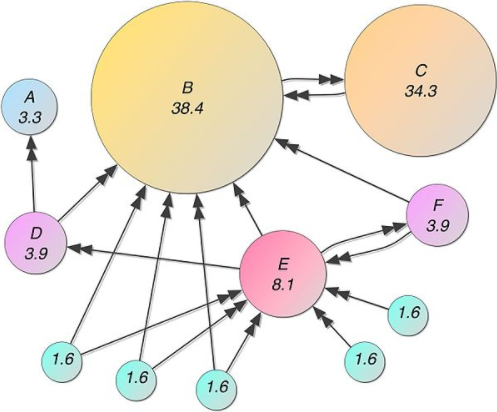
The higher the PageRank, the better the rankings and thus the greater the likelihood of being found in search engines.
PageRank in 2020 and beyond?
PageRank was invented by Google's two founders, Larry Page and Sergey Brin, during their studies at Stanford University in the USA. The first prototype of PageRank was introduced in 1998 and today forms the foundation of Google's approach to understanding the link value of websites.
PageRank was originally used directly and extensively by Google. Today, it is debatable to what extent Google still relies on the PageRank algorithm.
We do know, however, that Google weighs links based on factors including:
- Authority
- Relevance
- Trustworthiness
These factors are therefore decisive in link building. Read more about link building and how to succeed with it here.
Curious about how PageRank affects your website's visibility?
Contact us at 30 12 42 72 and we will help you understand and optimise your link building strategy!


