What is a script?
In programming and on the internet, "script" most commonly refers to the coding language JavaScript. A script is a piece of code that performs a specific function and can be executed either in the browser (client-side) or on the web server (server-side). Scripts are used to make websites work as intended by adding interactivity or automating tasks, such as form validation, registering button clicks, or tracking how far a user has scrolled on a page.
Scripts and SEO
Search engines like Google can read JavaScript, but they do not always execute scripts, especially if they require too much processing power. If important content such as links or text is only loaded via a script, this can harm SEO, as search engines may not register the content correctly.
JavaScript frameworks and SEO
Today, JavaScript frameworks such as React, Vue.js, and Angular have become even more popular, and many websites load dynamic content through these frameworks. Although these technologies are effective at creating interactive user experiences, they can introduce SEO challenges if search engines struggle to crawl dynamic content. It is therefore essential to use techniques such as Server-side Rendering (SSR) or static rendering, which make it possible to serve pre-rendered HTML to search engines. Technologies such as Next.js and Gatsby combine the benefits of dynamic applications with SEO-friendly content by generating static pages that can easily be crawled by Google and other search engines.
Dynamic Rendering – a solution of declining relevance
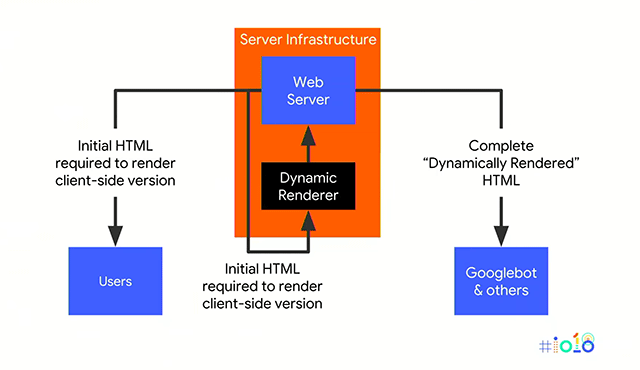
Previously, Dynamic Rendering was used to serve two versions of a website: one for regular users and one for search engines, so they could access the fully rendered content. However, Google has begun to discourage this approach and instead encourages the implementation of Server-side Rendering (SSR) or a hybrid solution. Dynamic Rendering remains a viable option, but it is no longer optimal as a long-term SEO strategy today.
This process looks roughly as follows:
Core Web Vitals and scripts
In recent years, Google has placed strong emphasis on Core Web Vitals, which measure performance, loading speed, and user experience on websites. Heavy JavaScript files can have a negative impact on these metrics. Today, it is important to optimise scripts so they do not degrade loading speed or interactivity on the website. It is therefore a good idea to minify and optimise JavaScript, for example by using lazy loading or asynchronous loading, to improve page speed and user experience.
How do you ensure optimal SEO with scripts?
To ensure that scripts do not harm your SEO, it is important to combine modern techniques such as Server-side Rendering, static site generation, and lazy loading of JavaScript. In addition, you should use tools such as Google Search Console to check whether your scripts are being correctly crawled by search engines and whether they are negatively affecting performance.
Are you unsure how scripts affect your website's SEO, or would you like to optimise your site's performance? We can help you ensure that your scripts work optimally without compromising your SEO. Fill in the form below or call us on 30 12 42 72 for a no-obligation chat!


